A successful press on nails collection should not begin with the question, “Which designs are trending?”
It should begin with a much more important question:
> Who exactly are we designing these nails for?
The answer influences almost every product decision that follows.
A customer looking for short, practical nails for everyday wear may prefer completely different shapes, colors, finishes, packaging, and product information from someone buying elaborate handmade nails for parties, weddings, or fashion content.
If a brand tries to serve both customers—and every other customer in between—with the same collection, the result can become confusing.
This is one of the biggest challenges when building a press on nails brand. The category offers enormous creative freedom, but that freedom can encourage brands to launch too many unrelated products before establishing who their main customer actually is.
A better approach is to define several specific customer groups, choose which one should drive the core assortment, and then develop supporting collections around adjacent needs.
This guide explains how to define the target customer for a press on nails brand and turn that customer profile into practical decisions about shapes, lengths, colors, artwork, packaging, product families, and future collection development.
Why Target Customer Comes Before Product Design
Imagine two brands selling press on nails.
The first targets customers who want a polished manicure for work, travel, dinners, and everyday routines.
Its collection might focus on:
- Short square
- Short almond
- Oval
- Nude
- Red
- Milky finishes
- Micro French
- Minimal decoration
The second targets customers who treat nails as fashion accessories and frequently change designs for events, outfits, photos, or social content.
Its collection might contain:
- Medium and long almond
- Coffin
- Stiletto
- Cat-eye
- Chrome
- 3D flowers
- Rhinestones
- Hand-painted artwork
Both can be strong businesses.
The problem appears when one brand launches both directions without explaining how they relate.
A customer may see twenty press on nails designs but still struggle to understand what the brand specializes in.
Defining the target customer gives the assortment a center.
Do Not Define the Customer Only by Age
A statement such as:
> “Our target customer is women aged 18–35.”
is not enough to build a product collection.
People within the same age range can have completely different reasons for purchasing press on nails.
A more useful customer profile describes behavior.
Ask:
- When does the customer wear press-ons?
- How often does she change nail designs?
- Does she prefer short or long nails?
- Does she value practicality or visual impact?
- Does she follow nail trends closely?
- Does she buy for everyday use or specific occasions?
- Does she prefer minimal or decorative designs?
- How comfortable is she choosing nail sizes?
- Where does she discover new nail designs?
- Is she buying one set or building a nail wardrobe?
These questions create much more useful product information than age alone.
Segment Press On Nails Customers by Use Case
One of the most practical ways to define the market is by wearing occasion.
Different use cases naturally create different product requirements.
Everyday Wear
These customers may want press on nails for normal routines rather than one specific event.
Possible priorities include:
- Shorter length
- Wearable shapes
- Neutral colors
- Easy-to-coordinate designs
- Clear sizing
- Simple application
Suitable products might include:
- Short square
- Squoval
- Short almond
- Nude
- Milky white
- Sheer pink
- Burgundy
- Micro French
This customer can become the foundation of a core collection.
Fashion and Self-Expression
Another customer treats press on nails more like accessories.
She may change them according to:
- Outfit
- Mood
- Season
- Trend
- Social content
This customer may respond more strongly to:
- Cat-eye
- Chrome
- Jelly
- Bright colors
- Handmade artwork
- Mismatched designs
- Medium almond
- Coffin
The product-development cycle may need to move more frequently because variety is part of the value.
Special Occasions
Some customers enter the category because they have a specific event.
Examples include:
- Wedding
- Prom
- Graduation
- Party
- Vacation
- Festival
- Holiday event
These customers may search for press on nails differently from everyday users because the event itself is driving the purchase.
The product should therefore be easy to understand by occasion.
Artistic Nail Customers
This group is attracted to the nail design itself.
They may value:
- Hand painting
- 3D flowers
- Pearls
- Charms
- Sculptural elements
- Detailed ten-finger compositions
For these customers, handmade craftsmanship can become a central brand differentiator.
Identify the Customer’s Preferred Length
Length is one of the strongest ways to separate customer groups.
A brand focused on practical press on nails may build heavily around:
- Short square
- Squoval
- Short almond
- Oval
A fashion-oriented brand may focus more on:
- Medium almond
- Long almond
- Coffin
- Stiletto
But do not assume that all customers belong completely to one side.
A customer may wear short nails during the week and longer designs for events.
This creates an opportunity to build a customer journey.
For example:
Everyday: short square
Weekend: medium almond
Special event: long almond
The same customer can potentially purchase several press on nails products if the assortment recognizes her different use cases.
Decide Whether Your Customer Is Minimal or Decorative
Design intensity is another useful segmentation variable.
A minimalist customer may prefer:
- Solid color
- Sheer finishes
- Micro French
- Small metallic accents
- One-color designs
A moderately fashion-focused customer may prefer:
- Cat-eye
- Jelly
- Chrome
- Small florals
- Pearls
A highly decorative customer may prefer press on nails with:
- Hand-painted artwork
- 3D flowers
- Rhinestones
- Charms
- Layered textures
Instead of forcing one customer to choose from everything, organize products so the design levels are obvious.
A brand can even build three collection levels:
Essential
Fashion
Handmade
This creates a clearer path through the assortment.
Understand Whether the Customer Follows Trends
Not every customer wants the newest design.
Some customers repeatedly buy familiar colors and shapes.
Others want something visibly different every season.
For trend-sensitive press on nails customers, the product calendar may include more:
- Seasonal colors
- New finishes
- Experimental artwork
- Limited designs
- Fashion capsules
For a core-focused customer, the assortment may rely more heavily on:
- Red
- Nude
- French
- Milky pink
- Black
- Proven shapes
Most brands need both.
The important question is the ratio.
A brand might decide:
60% core products
25% fashion products
15% experimental products
Another brand may reverse that structure.
The target customer should determine the mix.
Define the Customer by Nail-Art Confidence
Some customers already understand:
- Shape names
- Nail sizing
- Adhesive options
- Different finishes
- Application techniques
Others may be purchasing press on nails for the first time.
First-time customers may benefit from:
- Clear shape labels
- Clear length labels
- Simple size guidance
- Easy application instructions
- Complete kits
Experienced customers may be more comfortable choosing:
- Specific shapes
- Custom sizes
- Handmade products
- More unusual designs
This should influence both product design and packaging.
The more unfamiliar the target customer is with the category, the less the brand should assume she already understands.
Think About the Customer’s Sales Channel
Where customers discover the product can influence what kinds of press on nails deserve more attention.
Direct-to-Consumer Website
The brand has more room to explain:
- Shape
- Size
- Design process
- Materials
- Customization
- Product families
This can support more complex products.
Social-Driven Sales
Highly visual products may attract more initial attention.
Useful hero products might include:
- 3D flowers
- Chrome
- Cat-eye
- Handmade artwork
However, the full collection still needs products customers can imagine wearing regularly.
Physical Retail
Packaging becomes especially important.
Customers need to understand press on nails quickly from:
- Product visibility
- Shape
- Length
- Color
- Packaging information
A complicated design that requires several paragraphs of explanation may be harder to merchandise physically.
Turn the Customer Profile Into a Shape Strategy
Once the customer is defined, choose a small shape hierarchy.
For example, a wearable press on nails brand might use:
Hero: Short square
Secondary: Short almond
Alternative: Oval
A fashion brand might use:
Hero: Medium almond
Secondary: Coffin
Statement: Stiletto
A handmade brand might use:
Hero: Almond
Secondary: Coffin
Supporting: Oval
The point is not to restrict the brand permanently.
It is to create a recognizable starting structure.
Xingyi’s shape and size guide can help product teams compare available silhouettes, lengths, and sizing options while developing a target-customer-based assortment.
Turn the Customer Profile Into a Color System
Color should also reflect customer behavior.
An everyday customer might respond to a permanent palette containing:
- Nude
- Sheer pink
- Milky white
- Red
- Burgundy
A fashion customer might expect more:
- Blue
- Green
- Chrome
- Cat-eye
- Seasonal colors
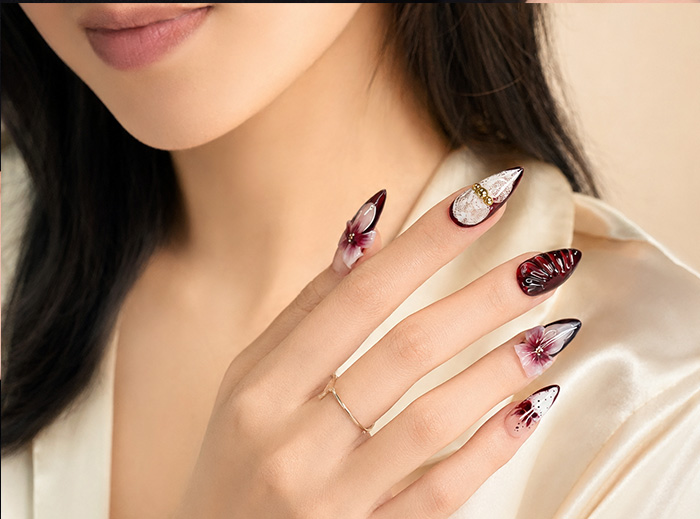
A handmade press on nails customer may respond to more complex combinations such as:
- Burgundy + gold
- Sheer pink + pearl
- Black + metallic
- Green + floral artwork
Do not choose every color independently.
Build a palette around the target customer.
Turn the Customer Profile Into a Packaging Brief
Packaging should reflect both the product and the customer’s familiarity with the category.
For first-time buyers, press on nails packaging should make basic information easy to find:
- Shape
- Length
- Nail count
- Included accessories
- Application instructions
For handmade products, packaging may also need:
- More product visibility
- Greater tray depth
- Protection for decoration
For private label collections, the packaging should connect these practical requirements with the brand’s visual identity.
Xingyi’s customized services can support development of shapes, artwork, decoration, logo, packaging, and complete set configuration.
Create One Primary Customer and Several Secondary Customers
A brand does not need to serve only one person forever.
A useful model is:
Primary Customer
This person drives the core assortment.
For example:
> She prefers medium almond press on nails, follows fashion trends, likes cat-eye and floral designs, and wants products that feel distinctive without becoming extremely dramatic.
Secondary Customer A
Prefers shorter everyday styles.
Secondary Customer B
Buys highly decorative nails for events.
Now the product architecture becomes clearer.
The primary customer gets most of the assortment.
Secondary customers receive supporting categories.
This is more manageable than treating every possible buyer equally.
Build a Sample Customer Profile
A useful customer profile should be specific enough to guide product decisions.
For example:
Customer: Fashion-conscious working customer
Main use: Everyday + weekend
Preferred length: Short to medium
Preferred shapes: Short almond, medium almond
Colors: Nude, burgundy, pink, seasonal fashion shades
Design: Cat-eye, micro florals, metallic accents
Occasion: Work, dinners, travel, parties
Design intensity: Moderate
Packaging need: Clear sizing and application information
From this profile, a brand can immediately make decisions about its press on nails assortment.
It does not need twenty long stiletto products.
It probably does need several medium almond designs.
Use Customer Profiles to Build Product Families
Once the customer is clear, create related products.
Suppose the primary customer likes medium almond, burgundy, and moderate decoration.
A product family might include:
- Glossy burgundy almond
- Burgundy cat-eye almond
- Burgundy micro French
- Burgundy floral almond
- Burgundy and gold handmade set
These press on nails share a recognizable customer and design language.
This is stronger than launching five unrelated trend products.
Product families also make future development easier because successful colors, shapes, and finishes can be extended rather than reinvented.
Let Hero Products Stretch Beyond the Core Customer
A brand’s hero products can be slightly more dramatic than the everyday assortment.
For example, the core customer may prefer medium almond.
The campaign hero could use:
- Long almond
- 3D flowers
- Larger decoration
The hero still needs to feel connected through:
- Color
- Motif
- Finish
- Artwork
This allows press on nails marketing to create visual impact without forcing the entire assortment into extreme designs.
Hero products attract attention.
Core products support broader everyday demand.
Review Customer Assumptions After Launch
The original target customer is a hypothesis.
After products are available, compare the plan with actual behavior.
Review:
- Which shapes receive the most interest?
- Which lengths are requested?
- Which colors generate repeat demand?
- Which press on nails lead to inquiries?
- Which designs are reordered?
- Which products receive little attention?
- Which sizing questions appear repeatedly?
- Which customer groups are appearing unexpectedly?
Then adjust the assortment.
For example, a brand may discover that its handmade long products attract attention but short almond products generate more repeat inquiries.
That information should influence the next collection.
Use a 30/60/90-Day Product Review
A simple review cycle can help brands avoid waiting too long before learning from a new press on nails collection.
After 30 Days
Look for early signals:
- Product-page interest
- Customer questions
- Sample requests
- Shape preferences
- Initial inquiries
Do not make major conclusions from limited data, but identify obvious problems.
After 60 Days
Compare product families.
Ask:
- Which colors consistently attract attention?
- Which designs are being compared?
- Are customers asking for other lengths?
- Are particular press on nails becoming clear leaders?
After 90 Days
Make assortment decisions.
Possible actions include:
- Expand
- Recolor
- Simplify
- Adapt to another shape
- Keep as core
- Replace
- Discontinue
This turns customer definition into an ongoing commercial process rather than a one-time branding exercise.
Common Target Customer Mistakes
Defining Customers Only by Age
Behavior is more useful than demographics alone.
Trying to Serve Everyone
A brand needs a recognizable center.
Assuming Trend Followers Want Only Long Nails
Trend-sensitive customers may also prefer short shapes.
Assuming Everyday Customers Want Only Nude
Wearable length and strong color can coexist.
Creating Too Many Customer Personas
Start with one primary customer and a few meaningful secondary groups.
Designing Products Before Defining the Customer
Product decisions become much easier when the customer comes first.
Never Updating the Customer Profile
Actual inquiries and product performance should refine the original assumptions.
A Practical Eight-SKU Customer-Led Collection
Suppose the primary customer prefers fashionable but wearable press on nails.
A first collection might contain:
1. Short Square Milky Pink
Everyday basic.
2. Short Almond Burgundy
Strong core color.
3. Medium Almond Micro French
Wearable fashion.
4. Medium Almond Pink Cat-Eye
Trend-led core.
5. Medium Almond Floral
Signature artwork.
6. Medium Almond Black and Gold
Evening product.
7. Long Almond 3D Floral
Campaign hero.
8. Seasonal Medium Almond
Rotating color or finish.
Seven of the eight products remain close to the primary customer’s preferences.
Only the hero stretches substantially beyond them.
That creates a much more focused press on nails assortment.
Questions to Answer Before Developing the Next Collection
Before approving new products, ask:
- Who is our primary customer?
- When does this customer wear press-ons?
- Which shapes does she prefer?
- Which lengths fit her lifestyle?
- Does she prefer minimal or decorative designs?
- How trend-sensitive is she?
- Which colors fit her wardrobe and occasions?
- Does she understand sizing?
- Which sales channel does she use?
- Which current products already serve her?
- What customer need does the new SKU add?
If the product team cannot explain which customer a new design is for, the SKU may not need to exist.
Conclusion
Defining the target customer is one of the most important decisions when building a press on nails brand.
The goal is not to create one fictional person and refuse to sell to anyone else.
The goal is to establish a clear primary customer who can guide decisions about:
- Shape
- Length
- Color
- Finish
- Artwork
- Decoration
- Packaging
- Product families
From there, secondary customer groups can expand the assortment without making the brand feel unfocused.
A strong press on nails collection usually has a recognizable center. Customers should be able to look at several products together and understand who they were designed for.
Once the collection launches, use real customer behavior to refine that profile. Review which shapes generate interest, which colors are repeatedly requested, which products lead to inquiries, and which designs deserve to become permanent.
For brands developing customer-specific press on nails, Xingyi’s shape and size guide, handmade custom press-on nail collection, and customized services can help translate customer preferences into physical products.
When you have defined your target customer, preferred shapes, design intensity, color system, packaging direction, and planned assortment, you can contact Xingyi to discuss sample development for your next press on nails collection.