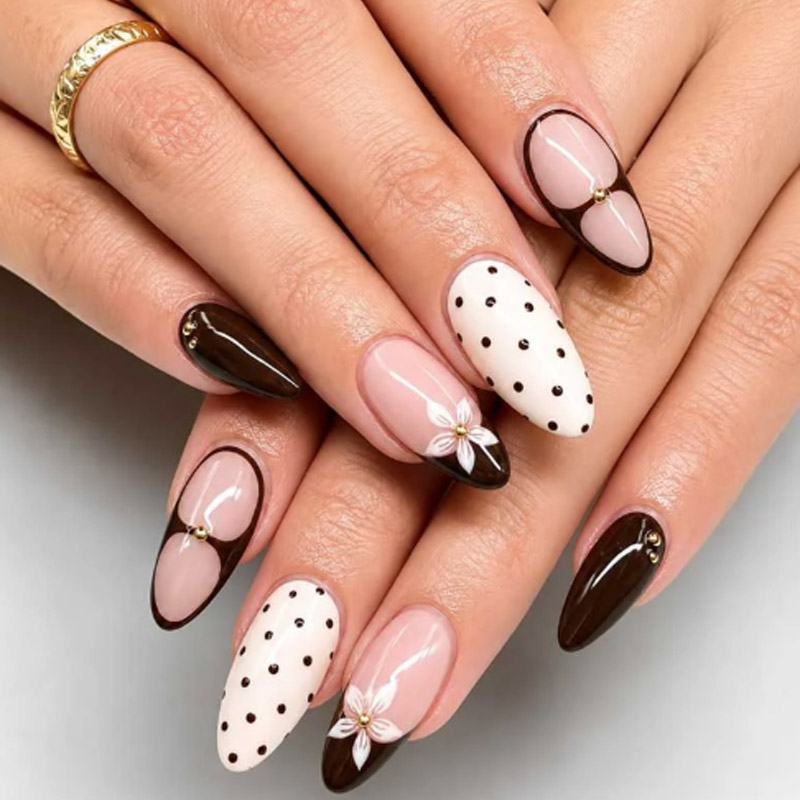
When beauty brands compare nail samples, flexibility is often treated as a simple quality test.
A buyer bends one nail and says:
“This one feels softer, so it must be better.”
That conclusion can be misleading.
The performance of flexible press on nails depends on much more than how easily a single nail tip bends between two fingers. Material, thickness, nail shape, length, curvature, width, and even where the thickness is distributed across the nail can all influence how the finished product behaves.
A very flexible short nail may feel completely appropriate, while the same flexibility in a long, heavily decorated coffin nail may produce a very different product experience. A thick nail may feel rigid even when made from the same material as a thinner nail.
This is also why material terminology alone is not enough. ABS, for example, is a family of plastics with grades differentiated by properties such as tensile modulus and impact strength rather than one material with one fixed mechanical behavior.
開発するブランド向け flexible press on nails, the better question is therefore not:
“How soft is this nail?”
It is:
“Does the thickness, flexibility, curvature, and shape work together appropriately for this product?”
This guide explains how buyers can evaluate flexibility during sampling without assuming that softer, thinner, or more bendable automatically means higher quality.
What Makes Flexible Press On Nails Flexible?
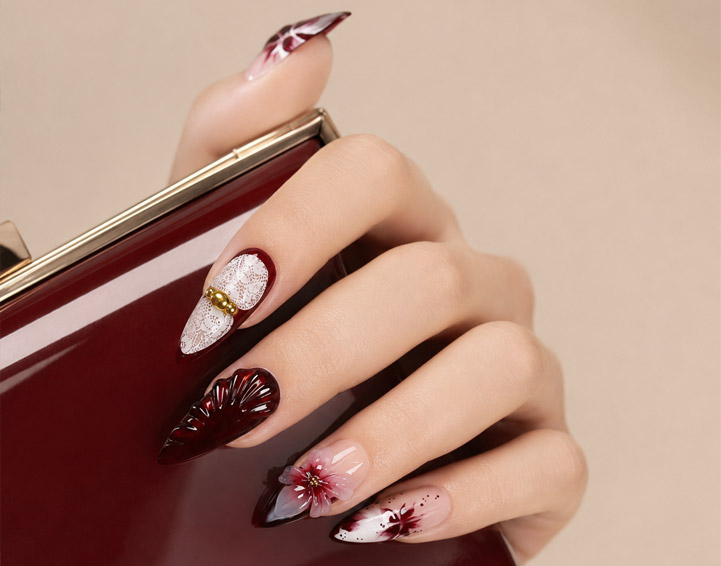
Several factors determine how a press-on nail responds when pressure is applied.
The main ones include:
- Base material
- 材料グレード
- Nail thickness
- Thickness distribution
- Nail width
- 釘の長さ
- Nail curvature
- ネイル形状
This is important because two flexible press on nails made from the same broad material category can still feel noticeably different.
A thin short almond nail and a thick long coffin nail do not have the same geometry.
Even material testing standards recognize that specimen dimensions and test conditions can affect measured flexural behavior. ISO 178, which covers flexural testing of rigid and semi-rigid plastics, notes that specimen dimensions, testing conditions, and other variables influence the results.
For a press-on nail buyer, the practical lesson is straightforward:
Compare finished products—not material names alone.
Thickness and Flexibility Are Closely Connected
Thickness is one of the strongest factors influencing how flexible press on nails feel.
In general, changing thickness changes the structural behavior of a moulded plastic part.
However, buyers should not reduce the specification to one number.
A press-on nail may have different thicknesses at:
- The cuticle edge
- The center
- The free edge
Those areas perform different roles.
Cuticle Area
The cuticle-side edge strongly influences how the nail looks once applied.
A thick, bulky edge can make the product appear more obviously artificial.
向け flexible press on nails, the cuticle side may therefore benefit from a thinner visual profile while still remaining clean and properly formed.
Center Area
The center provides much of the nail’s structural feel.
If the center is extremely thin, the nail may flex more noticeably.
If it is substantially thicker, the nail may feel much more rigid.
Free Edge
The free edge affects both appearance and how the nail responds during normal handling.
For long shapes, this area becomes particularly important because greater length creates more leverage when pressure is applied.
A good sample review should therefore examine the thickness profile rather than simply asking:
“Is this nail thin?”
Thinner Does Not Automatically Mean Better
Thin nails can look refined, particularly near the cuticle.
But an extremely thin product is not automatically a higher-quality product.
向け flexible press on nails, reducing thickness can change:
- 柔軟性
- Shape retention
- エッジの動作
- 装飾サポート
- Overall feel
The correct thickness depends on the intended product.
Consider three examples.
Short Nude Square
The priorities may include:
- Natural-looking edge
- Comfortable-looking profile
- Moderate flexibility
- クリーンな表面
Medium Almond Cat-Eye
The product needs:
- Defined shape
- 制御された柔軟性
- Smooth magnetic finish
- Consistent curvature
Long 3D Coffin
The design may require:
- More structural support
- Stable decoration
- Controlled bending
- Sufficient packaging protection
All three could be sold as flexible press on nails, but they should not necessarily use identical thickness specifications.
More Flexible Does Not Automatically Mean Better Either
Another common assumption is that the best nail should bend as much as possible.
That can also be misleading.
The objective is usually controlled flexibility.
A product that is too rigid may be less forgiving when the tip curvature does not closely match a customer’s natural nail.
But a nail that flexes excessively may feel different from the intended product specification, particularly at longer lengths.
For buyers, a sample test should therefore look at:
- How easily the nail bends
- Where it bends
- Whether it returns toward its original shape
- Whether visible stress marks appear
- Whether different sizes behave similarly
Do not turn the test into a competition to find the softest nail.
The strongest flexible press on nails specification is the one that matches the product’s shape, length, and target customer.
Flexibility Should Be Evaluated Across Several Nail Sizes
A thumb tip and little-finger tip have very different dimensions.
If you test only the thumb, you may miss important differences across the size system.
When sampling flexible press on nails, compare at least:
- A large size
- A medium size
- A small size
尋ねる:
- Does the largest nail feel much more rigid?
- Does the smallest nail become excessively flexible?
- Does the thickness progression make sense?
- Does every size maintain the intended shape?
Size-to-size consistency matters because the customer wears a complete set rather than ten identical nail tips.
Nail Length Changes the Way Flexibility Feels
Length should always be considered when discussing flexible press on nails.
A short nail has relatively little free edge extending beyond the fingertip.
A long nail creates more leverage.
As a result, two products using similar materials and thicknesses may feel very different simply because one is longer.
Short Press-On Nails
These can often support a relatively flexible construction while maintaining a compact shape.
Typical options include:
- ショートスクエア
- スクオーバル
- ショートアーモンド
- オーバル
Medium Nails
Medium lengths need a balance between:
- Wearable profile
- Defined shape
- 制御された柔軟性
Long Nails
Long almond, coffin, and stiletto designs should be evaluated carefully because shape and length can amplify bending.
This is particularly important when the product also contains:
- チャーム
- Large rhinestones
- 3D フラワーズ
- 彫刻装飾
向け flexible press on nails, flexibility should therefore always be discussed together with length.
Nail Shape Also Changes Structural Behavior
Shape affects how a nail looks and how its dimensions are distributed.
広場
Square nails maintain more width toward the free edge.
ショートスクエア flexible press on nails can work well for everyday collections and simple finishes.
オーバル
Oval narrows gradually and can create a softer overall profile.
アーモンド
Almond tapers more noticeably toward the end.
Medium almond is particularly useful when brands want a combination of defined shape and wearability.
棺
Coffin narrows toward a flat free edge.
At longer lengths, its geometry should be tested carefully for both flexibility and shape retention.
スティレット
Stiletto creates the narrowest, most pointed free edge.
Long stiletto products need their own physical assessment rather than inheriting the specification from another shape.
ブランドはXingyi'sをレビューできます 形状とサイズのガイド when comparing shapes and lengths during sample development.
Curvature Can Matter More Than Extreme Flexibility
When customers describe a press-on nail as comfortable or easy to fit, flexibility may only be part of what they are experiencing.
Curvature also matters.
A natural nail can be:
- Relatively flat
- Moderately curved
- More strongly curved
If the press-on tip has a very different curvature, increasing flexibility may help the tip adapt somewhat, but it does not automatically solve every fit mismatch.
For this reason, brands developing flexible press on nails should inspect:
- Underside curve
- Sidewall curve
- 幅
- 形状
- 柔軟性
as a complete system.
A highly flexible nail with unsuitable dimensions may still be a poor choice for the target customer.
Do Not Use Bending by Hand as the Only Quality Test
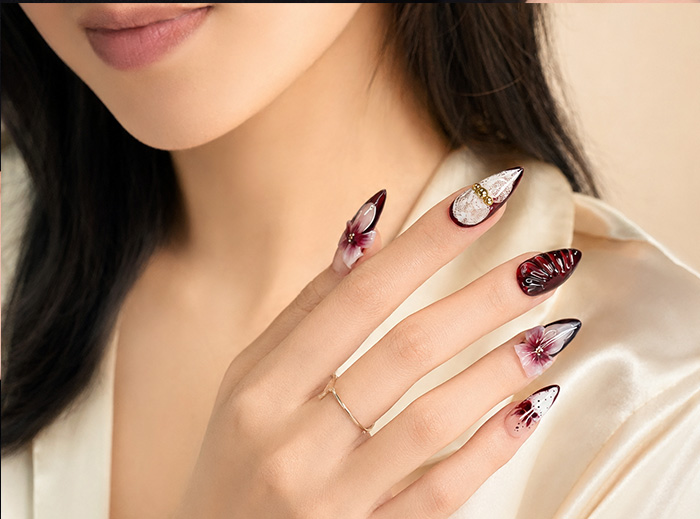
Bending a sample between your fingers is useful as a quick comparison.
It is not a complete technical test.
Manual pressure varies depending on:
- Who performs the test
- Where they hold the nail
- How much force they apply
- Which nail size they use
Standardized plastics testing exists precisely because mechanical properties need defined methods and conditions to be meaningfully compared. ISO 178 specifies a controlled method for evaluating flexural behavior of rigid and semi-rigid plastics rather than relying on subjective hand bending.
A beauty brand does not necessarily need laboratory flexural testing for every press-on nail SKU.
But the principle is useful:
If flexibility is an important specification or claim, define how you will evaluate it.
Create a Simple Internal Flexibility Comparison Method
For ordinary product development, brands can establish a repeatable internal comparison method.
例えば:
Step 1
Select the same nail size from each sample.
Step 2
Compare products at the same approximate length.
Step 3
Apply pressure in the same location.
Step 4
観察する:
- Bending
- Recovery
- ストレス ホワイトニング
- Cracking
- Permanent deformation
Step 5
Repeat with:
- 大型サイズ
- 中型サイズ
- 小型サイズ
This does not replace standardized laboratory testing.
It does create a more consistent way to compare flexible press on nails during supplier sampling.
Look for Stress Whitening
When some plastic components are bent, the stressed area may visibly become lighter or white.
During sample review, inspect whether repeated gentle bending creates:
- Whitening
- Fine cracks
- Surface damage
- Permanent deformation
If visible changes occur easily, discuss them with the manufacturer.
The goal is not to repeatedly bend nails far beyond their expected use simply to force a failure.
Instead, compare candidate flexible press on nails under the same reasonable conditions.
Surface Coatings Can Affect Perceived Flexibility
The customer does not handle only the base tip.
The finished nail may contain several layers:
- Base nail
- Color coating
- Cat-eye layer
- クロム
- アートワーク
- 仕上げ層
These layers can affect how the finished product feels.
A decorated nail may feel different from an undecorated blank tip.
つまり flexible press on nails should eventually be evaluated as finished products, not only as raw transparent nail tips.
This becomes particularly important when comparing:
- Thick gel-like surfaces
- Multiple decorative layers
- 3D designs
The approved sample should represent the final construction.
Heavy Decoration Changes the Product Requirement
A nail carrying large decorative elements is not equivalent to a simple solid-color nail.
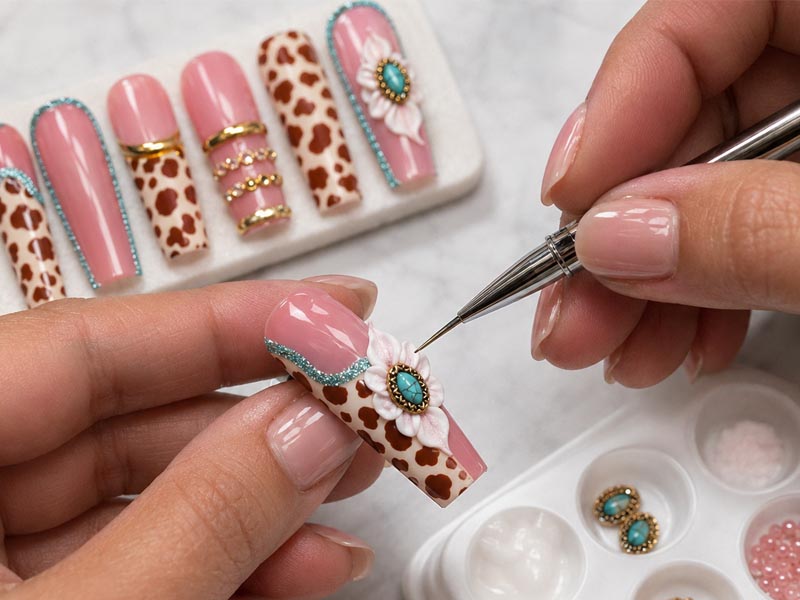
装飾されるため flexible press on nails, evaluate whether the base provides an appropriate platform for:
- 真珠
- ラインストーン
- チャーム
- 3D フラワーズ
A very flexible base combined with a relatively rigid decorative component may create additional movement around the attachment area.
This does not mean decorative nails must always be rigid.
It means the complete design should be tested physically.
ブランドはXingyi'sをレビューできます 手作りカスタムプレスオンネイルコレクション when comparing simpler and more highly decorated product structures.
Thickness Should Remain Visually Consistent Across a Set
Customers may notice when one nail appears significantly bulkier than another.
向け flexible press on nails, inspect the complete set from:
- Top view
- Side view
- Cuticle edge
- Free edge
Look for unexpected differences.
The thumb will naturally be larger than the little-finger nail, but the product family should still feel intentionally designed.
If one small nail suddenly has an unusually thick edge, the issue may be visible even before application.
Evaluate the Cuticle Edge Closely
The cuticle side is particularly important for perceived product quality.
チェック:
- 端の厚さ
- 滑らかさ
- 形状
- 表面仕上げ
- Symmetry
For nude or sheer flexible press on nails, this area can be especially visible.
A product can have excellent artwork yet still feel less refined if the cuticle edge is bulky or inconsistent.
The edge should therefore be part of the sample approval checklist rather than treated as a minor detail.
Material Documentation Should Match the Actual Nail Tip
If a supplier says its flexible press on nails use ABS, ask what material documentation is available.
ABS itself is not one uniform grade. ISO 19062-1 differentiates ABS materials using properties including tensile modulus, impact strength, melt-flow characteristics, composition, intended processing, additives, and other information.
ISO 19062-2 separately specifies preparation and testing methods used to determine ABS material properties.
For buyers, that means:
“Made from ABS”
does not by itself specify exactly how flexible the finished nail should be.
The final nail geometry and manufacturing process still matter.
Avoid Unsupported “Ultra Flexible” Claims
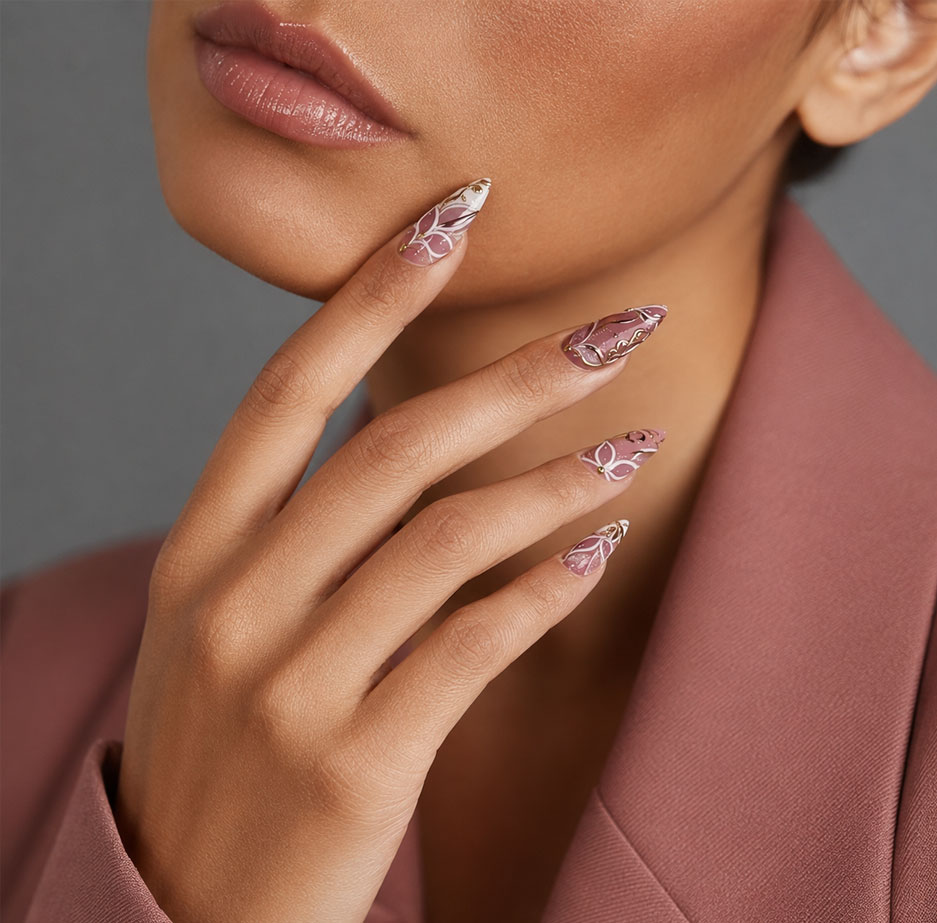
Flexibility can be useful as a product characteristic, but marketing language should remain supportable.
Claims such as:
- Most flexible
- Unbreakable
- Fits every nail
- Never cracks
require evidence that goes far beyond simply bending one sample.
A better product description can focus on clearly documented characteristics such as:
- 材料
- 形状
- サイズ範囲
- Thickness design
- Available finishes
If a brand wants to make measurable flexibility claims about flexible press on nails, it should first determine what test method and evidence support those claims.
Sampling Flexible Press On Nails
A useful sample review should cover more than flexibility.
形状
- Is the silhouette correct?
- Does it remain consistent across sizes?
厚さ
- Is the cuticle edge controlled?
- Does thickness look balanced?
- Is the free edge appropriate?
柔軟性
- Does the nail bend in a controlled way?
- Does it recover?
- Does visible stress appear?
曲率
- Is the underside profile appropriate?
終了
- Is the surface smooth?
- Are coatings consistent?
装飾
- Are decorative elements secure?
- Does nail movement affect them?
Complete Set
- Do all sizes feel like one product family?
This creates a much stronger basis for approving flexible press on nails.
Compare Equivalent Products
If you are comparing two suppliers, try to compare similar products.
例えば:
Medium almond vs medium almond
rather than:
Short square vs long coffin
If shape, length, material, and thickness all change at once, it becomes difficult to understand why one nail feels more flexible.
For useful supplier comparison, control as many variables as possible.
次に、次のように評価します:
- 厚さ
- Bend behavior
- 曲率
- エッジ品質
- 終了
This gives buyers more meaningful information.
Keep an Approved Physical Reference
Once a flexible press on nails sample is approved, retain it.
Label it with:
- SKU
- 形状
- 長さ
- 材料
- Approval date
Future production can then be compared with the reference.
If a later batch suddenly feels substantially more rigid or thinner, the physical sample gives the buyer and supplier something concrete to discuss.
This is particularly useful for long-term private label products.
Ask Whether Material or Mould Changes Will Be Communicated
A successful product may be reordered months later.
If the manufacturer changes:
- Raw material
- 材料グレード
- Nail mould
- 厚さ
- 曲率
the resulting product may feel different.
For established flexible press on nails, buyers should therefore ask suppliers to communicate meaningful structural changes before repeat production.
If necessary, request another sample before approving the changed version.
Packaging Still Needs to Fit the Final Thickness and Curve
Packaging is often designed after the nail sample is nearly complete.
The tray needs to accommodate:
- Nail curvature
- Nail thickness
- 装飾
- Overall height
A more curved product may sit differently in the tray than a flatter tip.
もし flexible press on nails also contain large 3D decoration, the packaging needs additional clearance.
Xingyi の カスタマイズされたサービス can support discussions around material, nail shape, decoration, and private label packaging as one product-development project.
Common Flexibility and Thickness Mistakes
Assuming Softer Means Better
The correct flexibility depends on the product.
Assuming Thinner Means Better
Thickness needs to support shape, finish, and decoration.
Testing Only the Thumb
Compare multiple sizes.
Ignoring Length
Long nails behave differently from short nails.
Comparing Different Shapes
Use comparable products whenever possible.
Focusing Only on Material
Geometry strongly influences finished behavior.
Testing Raw Tips but Not Finished Nails
Final coatings and decoration matter.
Making Strong Flexibility Claims Without Evidence
Define the property before marketing it.
Forgetting the Golden Sample
Reorders need a physical reference.
A Practical Buyer Checklist
承認する前に flexible press on nails, 、確認する:
- Base material identified
- 形状承認
- Length approved
- Size range reviewed
- Cuticle thickness checked
- Center thickness checked
- Free edge checked
- Flexibility compared across sizes
- Shape recovery observed
- Stress whitening checked
- Curvature reviewed
- Finished surface inspected
- Decoration compatibility confirmed
- 包装テスト済み
- 黄金のサンプル保持
If these areas are clear, the buyer has a much stronger product specification than simply stating that the nail should be “soft.”
結論
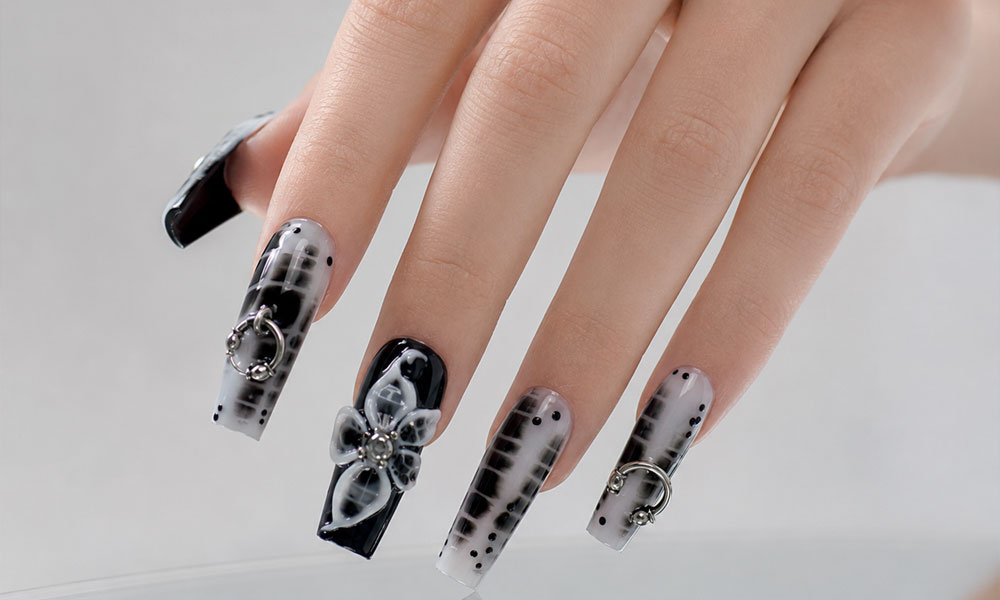
The quality of flexible press on nails should not be judged by how far one nail can bend.
Flexibility is the result of several variables working together:
- 材料
- 厚さ
- 形状
- 長さ
- 幅
- 曲率
- Finished construction
Even within a material family such as ABS, different grades can have different mechanical properties, and standardized plastics testing recognizes that material properties need controlled test conditions to be meaningfully compared.
For beauty brands, the most useful approach is to evaluate the actual finished product.
Compare equivalent shapes and lengths, inspect several sizes, review thickness at different parts of the nail, check for visible stress or permanent deformation, and make sure the amount of flexibility fits the product’s intended use.
A short everyday nail and a long decorated hero product do not necessarily need the same structural behavior.
If you are developing flexible press on nails, 、 Xingyi の を レビュー でき materials information, 形状とサイズのガイド, 、 および カスタマイズされたサービス while preparing your sample requirements.
When your target material, shape, length, thickness profile, decoration, and packaging requirements are defined, you can 連絡 Xingyi to discuss physical samples and determine which construction best fits your collection.