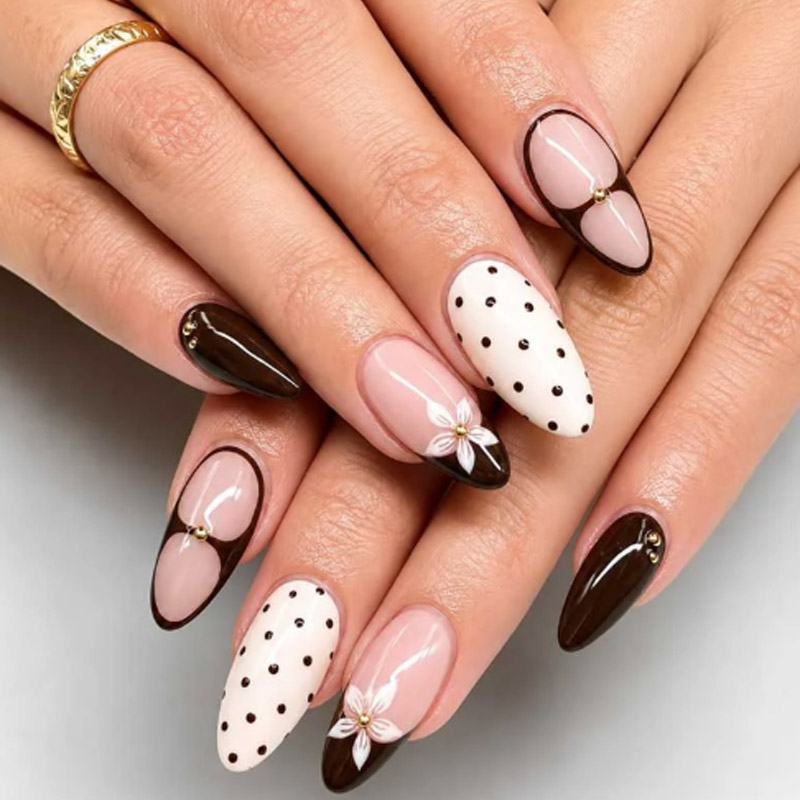
La frase salon quality press on nails appears frequently in product descriptions, packaging concepts, and supplier discussions, but it can mean very different things depending on who is using it.
One brand may use the phrase to describe a glossy gel-like finish. Another may associate it with flexible nail tips. A supplier may focus on handmade artwork, while a retailer may think primarily about fit, natural-looking curvature, and a complete application kit.
For beauty brands sourcing private label products, that creates an important question:
> What physical specifications actually make salon quality press on nails feel different from an ordinary set?
The answer should not depend on one material name or one marketing claim.
A finished press-on nail is a system. The base tip material, thickness, curvature, size range, surface finish, artwork, decoration, edge quality, packaging, and application method all influence the customer’s experience.
Material is still important, but saying that one polymer automatically creates salon quality press on nails can oversimplify the product. ABS itself, for example, is a recognized family of thermoplastic materials whose properties can differ according to composition, additives, processing method, impact strength, and other characteristics. The ISO 19062 standards for ABS materials illustrate why the name of a material alone does not describe every property of a finished moulded product.
For buyers, a better approach is to define quality through measurable product requirements.
This guide explains how to choose a base material, evaluate thickness and flexibility, inspect shape and curvature, control finishes and handmade decoration, and build a practical specification for salon quality press on nails.
Start by Defining What “Salon Quality” Means for Your Brand
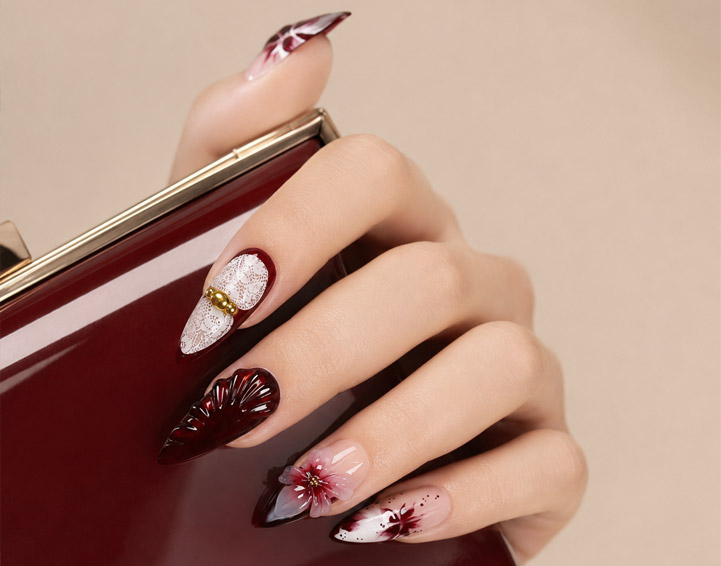
Before comparing materials, decide what customers should experience when they open and wear the product.
La frase salon quality press on nails is useful only when the brand can translate it into actual characteristics.
For example, your definition might include:
- Natural-looking curvature
- Clean cuticle-side edges
- Consistent thickness
- Finitura superficiale liscia
- Accurate sizing
- Controlled flexibility
- Opere d'arte dettagliate
- Secure decoration
- Clear application instructions
- Well-organized packaging
Another brand may define salon quality press on nails differently because it sells highly decorative handmade products rather than everyday minimalist sets.
The important point is to define the expectation before choosing materials.
If your customer values realistic short nails, the main priorities may be:
- Thin-looking edges
- Natural curve
- Multiple sizes
- Clean neutral colors
If your customer buys artistic statement products, the priorities may shift toward:
- Stable base tips
- Large design area
- Secure decoration
- Coerenza superficiale
- Packaging protection
There is no single material specification that solves every use case.
Base Material Is Only One Layer of Salon Quality Press On Nails
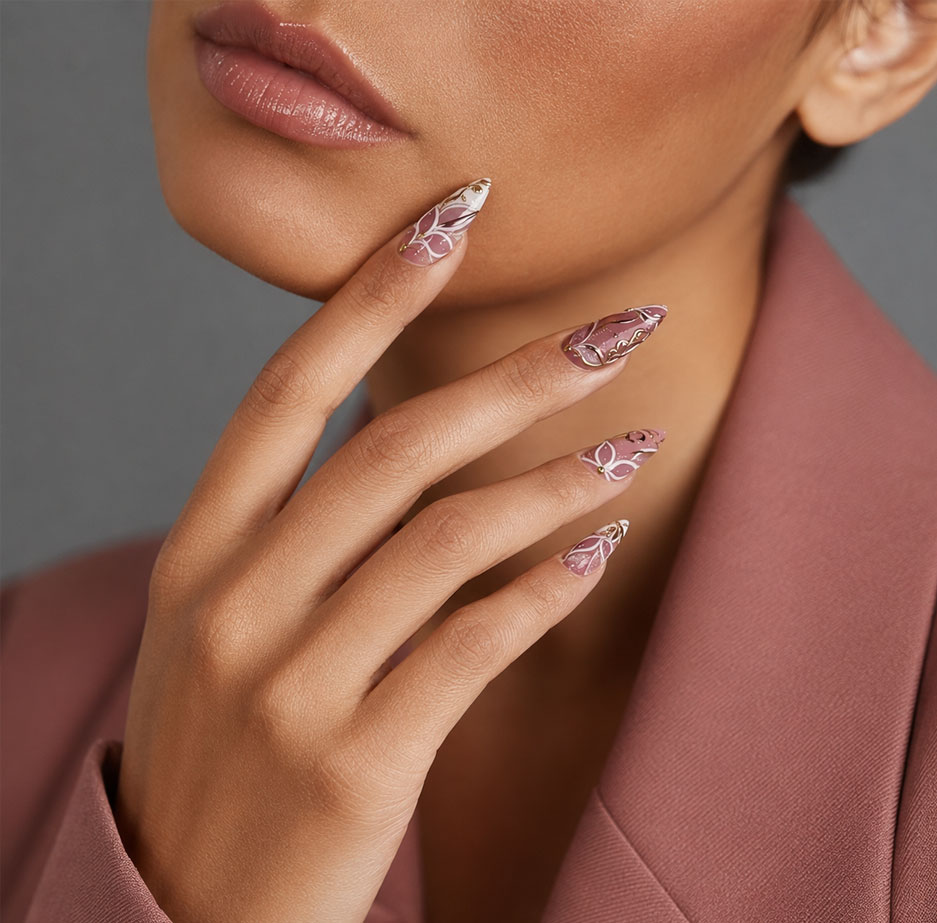
A finished press-on nail can contain several functional and decorative layers.
A simplified construction might include:
- Base nail tip
- Surface preparation or base layer
- Colore
- Special-effect layer
- Opera d'arte
- Decorazione
- Finishing layer
The customer sees and touches the complete structure.
Ciò significa salon quality press on nails cannot be evaluated solely by asking whether the base tip is ABS, gel-based, acrylic-based, or another material.
Imagine two products using the same base polymer.
Product A has:
- Poor mould consistency
- Thick edges
- Uneven color
- Rough artwork
- Limited sizing
Product B has:
- Controlled shape
- Balanced thickness
- Smooth coating
- Clean hand-painted details
- Better size coverage
They may begin with the same material family but create very different customer experiences.
For buyers, material should therefore be evaluated together with manufacturing and finishing quality.
Understanding ABS as a Base Material
ABS stands for acrylonitrile-butadiene-styrene.
It is a thermoplastic family widely used in moulded products. ISO maintains specific standards for ABS moulding and extrusion materials, including systems for classifying properties such as impact strength, tensile modulus, flow behavior, composition, and additives. You can review the ISO description of ABS material specifications when looking at the broader technical meaning of the material.
For press-on nail manufacturing, moulded ABS tips can provide a standardized foundation for:
- Forma
- Lunghezza
- Larghezza
- Curvatura
- Surface decoration
ABS can therefore be used in salon quality press on nails, but the material name itself should not be treated as proof of finished-product quality.
Buyers still need to evaluate:
- Which ABS specification is being used
- Tip thickness
- Mould quality
- Flessibilità
- Edge finishing
- Surface preparation
- Coating compatibility
- Size consistency
A high-quality ABS-based product and a poorly made ABS-based product are not the same thing.
Be Careful With “Soft Gel” Terminology
Another common material description is “soft gel.”
Per gli acquirenti in via di sviluppo salon quality press on nails, this term should be clarified carefully.
“Soft gel” may refer to different things in different product categories. In professional nail services, it can refer to gel-based enhancement systems that are cured as part of application. In finished press-on products, suppliers may also use phrases such as:
- Soft gel tips
- Gel press-ons
- Gel-like nails
- Flexible gel nails
Before comparing these products with ABS, ask:
- What is the actual base material?
- Does the customer need a lamp?
- Does “gel” describe the tip or only the coating?
- Is the product a finished press-on or a salon extension component?
- What physical difference can be measured?
A buyer should never select a material for salon quality press on nails simply because one terminology sounds more premium.
The physical sample matters more than the label.
Thickness Is One of the Most Important Variables
Thickness strongly affects how salon quality press on nails look and feel.
A nail that is too bulky can appear artificial, particularly around the cuticle and sidewalls.
A nail that is excessively thin may not provide the intended structural feel for the product.
However, there is no universal ideal thickness that applies to every shape and every material.
Thickness should be evaluated according to:
- Forma
- Lunghezza
- Larghezza
- Curvatura
- Material
- Decorazione
- Cliente target
A short square tip may need a different construction from a long coffin tip.
The buyer should also recognize that a nail may not have identical thickness from one end to the other.
Useful inspection points can include:
Cuticle-Side Thickness
The edge near the cuticle has a major effect on how natural the product appears.
Per salon quality press on nails, this area should generally look clean and controlled rather than unnecessarily bulky.
Center Thickness
The center contributes to the structural behavior of the tip.
Free-Edge Thickness
The tip should remain visually clean without creating an excessively heavy edge.
Instead of asking only:
> “Is this nail thin?”
ask the manufacturer to explain or provide samples showing how thickness changes across the product.
Flexibility Should Be Controlled, Not Maximized
Another common assumption is:
> Softer nails are always better.
That is too simple.
The right level of flexibility depends on the intended salon quality press on nails design.
A tip that is excessively rigid may be less forgiving when it does not closely match the natural nail curvature.
A tip that is excessively flexible may not deliver the intended feel, particularly in longer shapes or highly decorated products.
Useful sample checks include:
- Gentle side-to-side flexibility
- Shape recovery
- Stress whitening
- Edge behavior
- Flexibility across different sizes
Do not test only the largest nail.
A small tip and a thumb tip may behave differently.
Per salon quality press on nails, the target should be predictable physical behavior across the entire size family.
Curvature Can Matter as Much as Material
Press-on nails sit over a natural nail plate that has its own shape and curvature.
A base tip with an unsuitable curve can create fit problems even if the material itself is excellent.
When evaluating salon quality press on nails, inspect the C-curve and overall underside profile.
Chiedi:
- Is the nail relatively flat or strongly curved?
- Does the curvature change appropriately across sizes?
- Does the product suit the target customer?
- Are there obvious gaps when the sample is fitted?
A wide range of customer nail profiles exists, so one curvature will never be perfect for everyone.
The brand’s goal is to choose a system that makes sense for its intended audience.
Quello di Xingyi guida di forma e dimensione can help buyers organize discussions about width, shape, length, and sizing before approving samples.
Size Range Is Part of Product Quality
A beautifully finished nail is not useful if customers cannot find a suitable size.
For that reason, size configuration should be included in the definition of salon quality press on nails.
Buyers should ask:
- How many widths are available?
- How are sizes measured?
- Is the progression between sizes logical?
- Can custom size combinations be packed?
- How many tips are included in each retail set?
- Can sizing kits be developed?
Do not assume that a larger number of pieces automatically means a better fit system.
The width distribution matters.
For example, adding multiple nearly identical sizes may provide less value than a carefully distributed range.
During sampling, measure or compare the complete size family.
Shape Consistency Matters Across Every Size
A collection may be sold as almond, coffin, square, oval, or another silhouette.
Per salon quality press on nails, that shape should remain recognizable across the size range.
Consider almond tips.
The thumb should not look like a rounded oval while the smaller nails suddenly become sharply pointed.
The same principle applies to coffin.
The largest size should not appear square while only the smallest sizes show a clear taper.
During sample approval, place all sizes together and check:
- Sidewall consistency
- Forma della punta
- Conicità
- Length progression
- Overall proportion
The customer sees the full set.
Quality needs to be evaluated at set level.
Cuticle-Side Design Has a Major Effect on Perceived Quality
One of the areas customers notice quickly is how the nail meets the cuticle area.
Per salon quality press on nails, ispezionare:
- Edge smoothness
- Edge thickness
- Forma
- Surface finish near the edge
- Whether decoration interferes with the area
Large artwork, thick coatings, or excess finishing material close to the cuticle can make a product look less natural.
This is especially important in:
- Nude products
- Disegni francesi
- Short nails
- Finiture trasparenti
because there is less artwork available to distract from the base shape.
Surface Quality Should Be Inspected Under Light
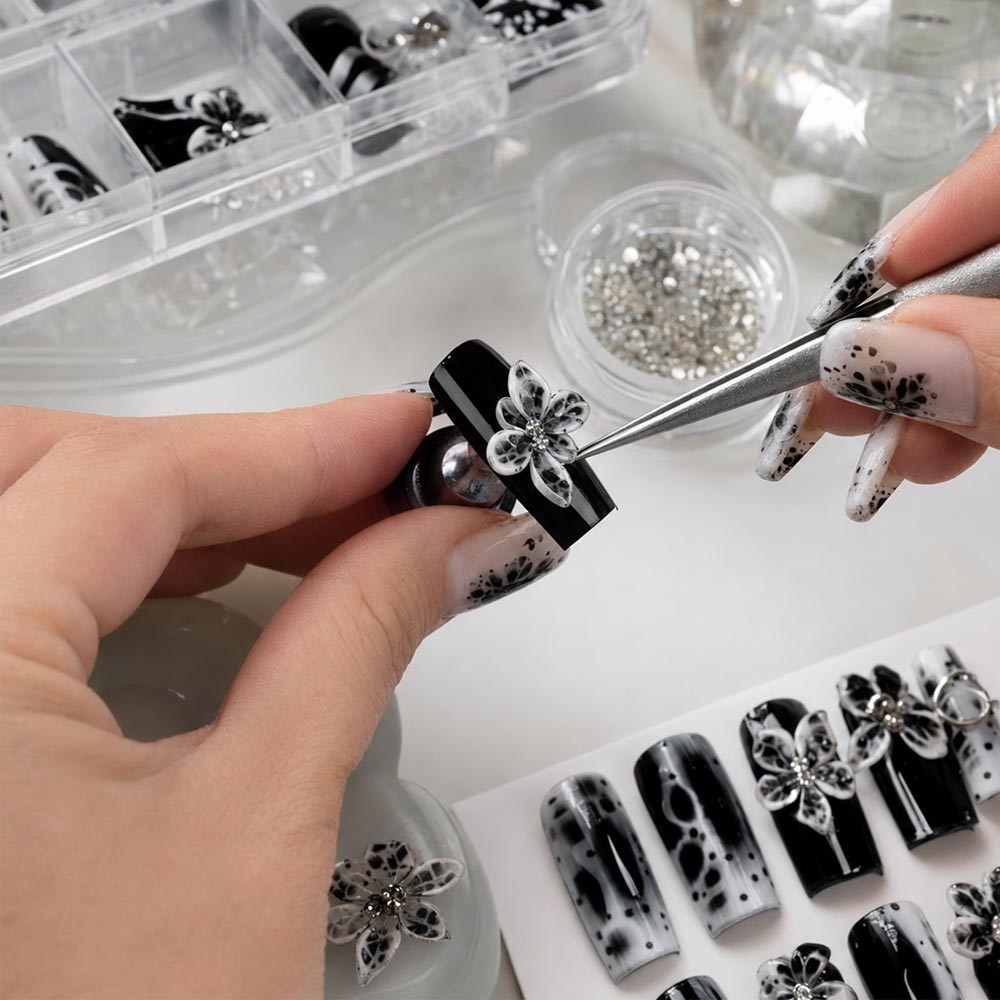
A glossy finish can hide some imperfections in photographs while making them very noticeable under direct light.
When evaluating salon quality press on nails, rotate the sample under consistent lighting.
Look for:
- Graffi
- Polvere
- Bolle
- Uneven gloss
- Coating marks
- Ondulazione superficiale
- Smudged artwork
For matte surfaces, look for:
- Uneven texture
- Glossy patches
- Finger marks
- Inconsistent finish
For chrome or metallic finishes, check:
- Uneven reflection
- Patchiness
- Edge coverage
Surface inspection should match the actual finish rather than using one checklist for every product.
A Gel-Like Appearance Does Not Require a Vague Material Claim
Some brands want salon quality press on nails to look similar to a freshly finished gel manicure.
That visual goal can be defined without relying on unclear material terminology.
Instead of writing:
> “Must look like premium gel.”
describe the visible characteristics.
Ad esempio:
- High-gloss surface
- Smooth reflection
- Consistent color depth
- Bordi puliti
- Controlled thickness
- No obvious moulding marks
This gives the manufacturer a more useful target.
A buyer can then compare physical samples and determine whether the finish meets the visual expectation.
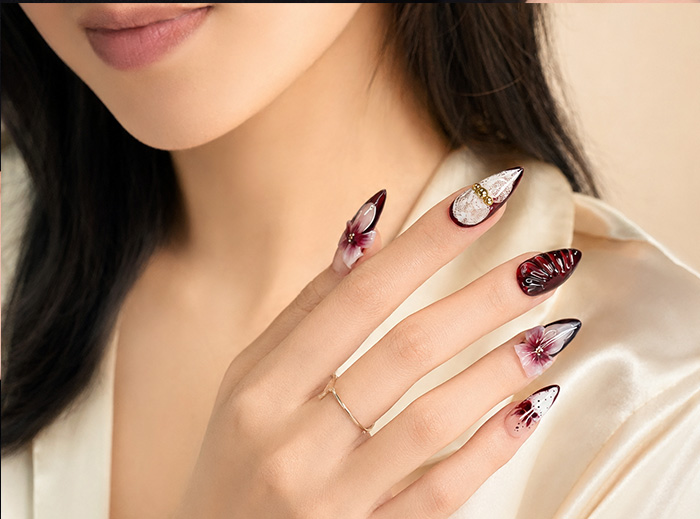
Handmade Work Can Increase Perceived Product Value—If It Is Controlled
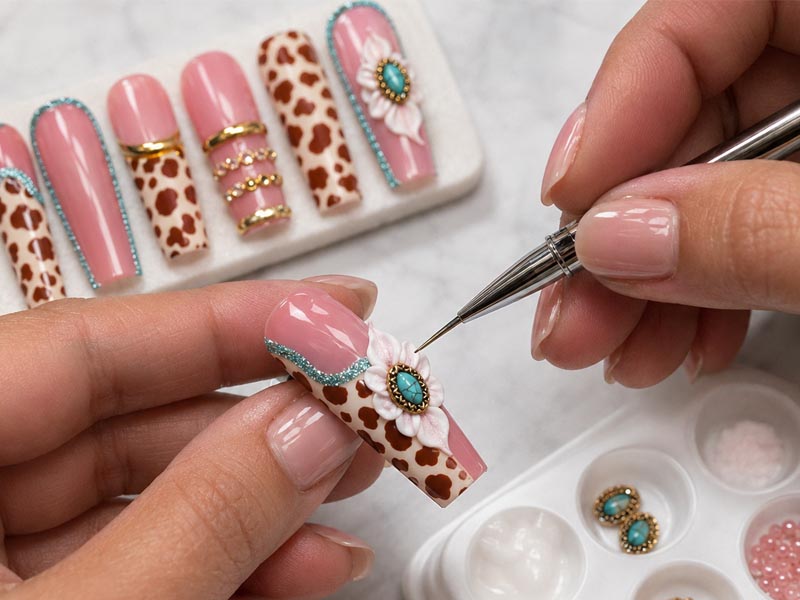
For decorative collections, salon quality press on nails may include manual processes such as:
- Pittura a mano
- Rhinestone placement
- Collocazione perla
- Foglio
- Charms
- Fiori 3D
- Layered gel artwork
Handwork creates additional possibilities, but it also introduces variation.
The buyer should distinguish between:
Acceptable Handmade Variation
Esempi:
- Minor brushstroke differences
- Slight changes in petal angle
- Natural foil variation
Unacceptable Product Errors
Esempi:
- Missing decoration
- Incorrect color
- Major placement difference
- Detached element
- Dirty surface
- Wrong nail design
Fatto a mano salon quality press on nails still need an approved standard.
The fact that something is made by hand does not mean every variation should be accepted.
Decoration Security Should Be Included in the Specification
A rhinestone or flower is not only a visual element.
It is also a physical component attached to the nail.
For decorated salon quality press on nails, ispezionare:
- Posizione
- Base contact
- Visible excess material
- Loose pieces
- Cracked elements
- Missing decoration
Large decorations should be assessed more carefully because they can place more stress on the attachment point during handling.
The brand should define how the finished product should look and what type of damage causes rejection.
Material Selection Changes With Design Complexity
A base tip for a simple nude product may have different practical requirements from one used in a long handmade set.
Consider three products.
Product A: Short Nude Square
Priorities:
- Aspetto naturale
- Controlled thickness
- Clean cuticle edge
- Good size system
Product B: Medium Almond Cat-Eye
Priorities:
- Forma consistenza
- Finitura superficiale
- Flessibilità
- Coating compatibility
Product C: Long 3D Floral Coffin
Priorities:
- Structural stability
- Decoration support
- Surface compatibility
- Autorizzazione all'imballaggio
All three may be marketed as salon quality press on nails, yet their ideal product specifications are different.
This is why brands should choose materials by SKU role rather than forcing one universal specification onto every collection.
Do Not Let Material Choice Overcomplicate the Assortment
Offering multiple materials can make a product range difficult to communicate.
A brand may eventually have:
- ABS-based products
- Another flexible-tip product
- Handmade sets
- Different surface systems
If customers cannot understand why those options exist, the assortment may feel unnecessarily complicated.
Per salon quality press on nails, organize products by customer benefit or design role instead of making the polymer name the entire product identity.
Ad esempio:
Everyday Collection
Collezione Moda
Collezione Handmade
Material information can still be provided within the specification.
But customers usually care about how the product looks, fits, and performs more than the technical name of the base polymer.
Sample Material Before Approving Artwork
If a brand is unsure which base structure to use, test undecorated or simple samples first.
Compare candidate tips for:
- Forma
- Thickness
- Flessibilità
- Curve
- Edge quality
- Size progression
Then select the base for the intended salon quality press on nails collezione.
This can be more efficient than creating complicated hand-painted artwork on several base materials before knowing which physical tip the brand prefers.
Once the structure is approved, move into:
- Colore
- Finire
- Opera d'arte
- Decorazione
Separating structural decisions from visual decisions can make sample review clearer.
Keep a Physical Material Reference Library
Brands planning ongoing development can benefit from keeping representative nail samples.
A simple material library might contain:
- Base tip samples
- Approved shapes
- Different thicknesses
- Surface finishes
- Cat-eye samples
- Chrome samples
- Handmade decoration
Label each reference.
Ad esempio:
MAT-A01 — Approved Medium Almond Base
FIN-C03 — Burgundy Cat-Eye Finish
DEC-F02 — Small 3D Flower
When developing new salon quality press on nails, the buyer can reference existing samples instead of explaining every requirement from the beginning.
This also improves consistency across future collections.
Ask for Material Documentation That Matches the Actual Product
Collecting documents is useful only when the documents correspond to what is actually being supplied.
If the product uses ABS tips, ask what material information is available for those tips.
If the supplier changes:
- Material grade
- Raw material source
- Coating
- Adhesive
- Decoration material
determine whether the change affects the documentation required by your brand.
Do not assume a general ABS data sheet automatically describes every finished salon quality press on nails product.
The finished set contains several components beyond the base tip.
Treat Adhesive as a Separate Component
A press-on nail kit may contain:
- Colla unghie
- Schede adesive
- Both options
These products should not be treated as the same component as the base nail tip.
For U.S.-bound products, the FDA explains that nail products are generally regulated as cosmetics when they meet the cosmetic definition and must be safe for consumers when used as directed. Labels must also contain appropriate warnings when necessary. Buyers can review the FDA Nail Care Products guidance nella valutazione del kit completo.
Per salon quality press on nails, this means the product brief should separate:
- Nail tip material
- Surface products
- Adhesive
- Accessori
Each may require different information.
Be Careful With “Non-Toxic,” “Hypoallergenic,” and Similar Claims
A material description is not the same thing as a safety claim.
Do not assume that using ABS or another material automatically supports phrases such as:
- Non tossico
- Ipoallergenico
- Senza sostanze chimiche
- Completamente sicuro
Per salon quality press on nails, marketing claims should be based on information relevant to the actual finished product.
The complete set can contain:
- Base polymer
- Colore
- Coating
- Decorative materials
- Colla
- Schede adesive
Claims should therefore be reviewed in the context of all included components.
A better approach is to communicate verifiable product characteristics such as:
- Material type
- Forma
- Finire
- Handmade decoration
- Size range
without making unsupported assumptions.
Packaging Can Change the Condition of the Product
A perfect nail can still arrive damaged if the packaging is unsuitable.
Per salon quality press on nails, packaging should protect:
- Forma
- Surface
- Decorazione
- Pointed edges
Long nails need sufficient length clearance.
3D products need sufficient height clearance.
Accessories should not move into the nail compartment during transport. The tray, lid, inserts, and accessory space should be tested together with the approved product.
Create a Salon Quality Product Specification
Translate the marketing goal into measurable requirements:
- Base material and supporting documentation
- Shape, length, width, curvature, and thickness
- Size progression and set configuration
- Flexibility expectations
- Cuticle-side profile and edge finishing
- Surface color, opacity, gloss, and artwork
- Decoration type, placement, and security
- Packaging clearance and accessory separation
- Approved physical sample
- Inspection and repeat-order records
Questo rende salon quality press on nails a controlled product standard rather than an undefined label.
Domande Frequenti
What makes salon quality press on nails different?
The difference should come from defined material, fit, shape consistency, surface finish, artwork, decoration, sizing, packaging, and application—not a vague claim alone.
Is one material automatically salon quality?
No. Thickness, curvature, manufacturing, coating, finish, design, and quality control can matter as much as the material name.
Should press-on nails be very flexible?
Not necessarily. Flexibility should suit the shape, length, thickness, and intended use without causing distortion or poor fit.
How should handmade decoration be inspected?
Use a complete approved set, written placement requirements, acceptable variation ranges, attachment checks, and defect examples.
What should brands approve before production?
Approve the complete nail set, material reference, dimensions, size mix, finish, artwork, decoration, packaging, accessories, and inspection specification.
Conclusione
Salon quality press on nails should be defined through verifiable product details. Material is one part of the system, but thickness, flexibility, curvature, fit, surface quality, decoration security, packaging, and application components all influence the finished result.
Develop physical references, measure the variables that matter, and avoid unsupported claims. A clear specification gives manufacturers and inspectors a practical standard for samples, production, and repeat orders.
To discuss a custom product-quality specification, contatta Xingyi with your material, shape, finish, artwork, sizing, decoration, packaging, and sampling requirements.